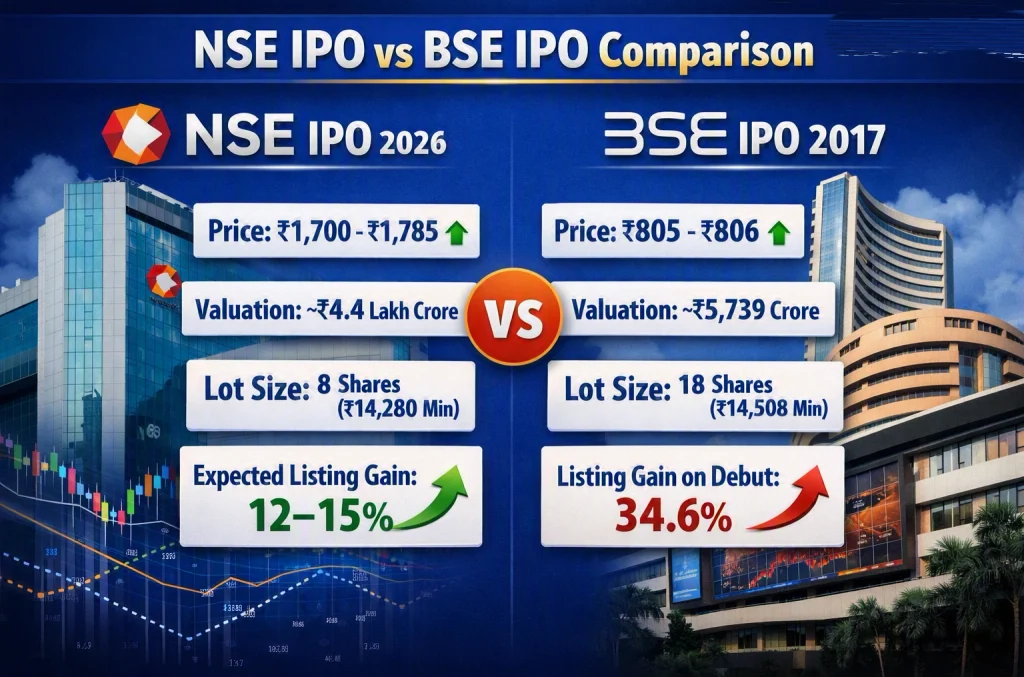
NSE IPO vs BSE IPO: India’s two major stock exchanges are now connected by an unusual IPO story. BSE Ltd had a blockbuster stock-market debut in 2017, gaining nearly 33% on its first trading day. Now, NSE Ltd is preparing for its much-awaited IPO in September 2026.
The big question for investors is simple: Can the NSE IPO deliver a listing gain similar to what BSE investors enjoyed in 2017?
NSE has fixed its IPO price band at ₹1,700 to ₹1,785 per share. The issue will open on September 17, 2026, and close on September 21, 2026. The IPO is expected to list on September 24, 2026.
NSE IPO vs BSE IPO: Key Numbers Of These IPOs
| Particular | NSE IPO 2026 | BSE IPO 2017 |
|---|---|---|
| IPO status | Upcoming | Completed |
| IPO opening | 17 Sep 2026 | 23 Jan 2017 |
| IPO closing | 21 Sep 2026 | 25 Jan 2017 |
| Listing date | 24 Sep 2026 | 3 Feb 2017 |
| Price band | ₹1,700–₹1,785 | ₹805–₹806 |
| Issue price | — | ₹806 |
| Lot size | 8 shares | 18 shares |
| Minimum investment | ₹14,280 | ₹14,508 |
| Issue size | ₹22,561.57 crore | ₹1,243.43 crore |
| Issue type | OFS | OFS |
| Listing exchange | BSE | NSE |
| Listing-day gain | Yet to be known | ~32.66% |
| Listing-day closing price | Yet to be known | ₹1,069.20 |
BSE’s 2017 IPO was priced at ₹806 per share. The stock opened at ₹1,085 on its listing day and eventually closed around ₹1,069.20, giving investors a gain of about 32.66% against the IPO price.
BSE IPO Delivered a Blockbuster Debut
When BSE listed in February 2017, investor interest was extremely strong.
The stock:
- IPO price: ₹806
- Listing price: ₹1,085
- Intraday high: ₹1,200
- Listing-day closing price: ₹1,069.20
- Gain at listing: 34.61%
- Gain at day’s close: about 32.66%
At its intraday high of ₹1,200, BSE shares were almost 49% above the IPO price.
That performance is now an obvious benchmark for investors looking at the NSE IPO.
What If NSE Gives the Same 32.66% Gain?
This is only a hypothetical calculation, not a prediction.
At the upper end of the NSE IPO price band:
NSE IPO price = ₹1,785
If NSE gains 32.66%, the implied price would be approximately:
₹1,785 + 32.66% = ₹2,368
For one lot of 8 NSE shares:
IPO investment: ₹1,785 × 8 = ₹14,280
Hypothetical value after a 32.66% gain:
₹2,368 × 8 ≈ ₹18,944
Potential profit: ~₹4,664 per lot
But investors should not treat this calculation as an expected listing price. NSE’s actual listing price will depend on demand, subscription, market conditions, and investor sentiment.
NSE IPO Is Much Bigger Than BSE’s IPO
The difference in scale is enormous.
BSE’s 2017 IPO was worth approximately ₹1,243 crore, while NSE’s current IPO is valued at about ₹22,561 crore at the announced issue size.
At the upper price band of ₹1,785, NSE’s implied valuation is around ₹4.4 lakh crore, putting it among India’s largest listed companies by market value.
This is one reason why investors should be careful when comparing the two IPOs purely on listing gains.
NSE IPO Valuation: Expensive or Reasonable?
NSE is entering the public market with a powerful position in India’s capital-market ecosystem.
According to recent analysis, NSE’s Q1 FY26 profit margin was around 58.78%, while transaction charges accounted for nearly 79% of revenue. The IPO valuation at the upper price band implies a P/E of roughly 35.4 times based on the cited post-IPO calculations.
That makes NSE a strong business, but investors also need to consider the valuation at which they are buying.
One Major Difference Between NSE and BSE IPOs
Both IPOs are Offer for Sale (OFS) issues.
This means the IPO money does not go to the exchange for expansion or new projects. Instead, existing shareholders are selling part of their holdings.
For NSE, the revised offer involves around 12.64 crore existing shares, with the offer size reduced from the earlier proposal.
Another interesting point is the listing venue.
NSE shares are expected to list on BSE, while BSE shares listed on its rival exchange, NSE, in 2017.
So the two IPO stories are almost mirror images:
BSE IPO → Listed on NSE
NSE IPO → Expected to list on BSE
Can NSE Repeat BSE’s Listing Gain?
There is no guarantee.
BSE’s 2017 IPO benefited from strong investor demand and a much smaller issue size. NSE is entering the market with a dramatically larger valuation and a much larger public offering.
Therefore, comparing the two only on percentage listing gains can be misleading.
Our view on these IPOs
BSE 2017: Strong historical listing performance
NSE 2026: Much larger business and IPO, but listing gain is still unknown
For investors, the more important question may not be “Will NSE list at a premium?”
It may be:
“At ₹1,785, does NSE offer enough long-term value to justify its valuation?”
That answer will depend on NSE’s earnings growth, derivatives dominance, regulatory environment, competition, and future market volumes.
NSE IPO vs BSE IPO: Final Verdict
If the comparison is purely about historical listing gains, BSE wins because it has already delivered a nearly 33% first-day closing gain.
If the comparison is about scale and market position, NSE’s IPO is in a completely different league.
The NSE IPO opens on September 17, 2026, and investors will have until September 21 to place their bids. The expected listing date is September 24, 2026.
NSE IPO could become one of India’s most closely watched market listings of 2026 — but BSE’s 2017 debut is a benchmark, not a guarantee of NSE’s listing performance.
Disclaimer: This article is for educational and informational purposes only. The hypothetical NSE listing-price calculation is based solely on BSE’s historical listing gain and should not be considered a prediction or investment recommendation.
Share